


King of the hill: how to allocate among the arms of an A/B/n test with correlated arms, decided on the top-k contenders (k = 2, 3).
pip install koth            # install from PyPI (numpy implementation)
pip install koth[torch]     # if you want to use Torch
pip install koth[arena]     # plus the benchmark arena
import numpy as np
import koth

# A control and two treatments, one epoch = one day. What each arm measured
# per day, and the share of the allocation it had that day: five days at an
# even split (synthetic here; yours come from your data).
rng = np.random.default_rng(5)
allocations = np.full((5, 3), 1 / 3)
outcomes = np.array([0.0, 3.0, 2.0]) + rng.normal(size=(5, 3)) * 30.0 / np.sqrt(allocations)

test = koth.Test(rho=0.01, sigma=30.0)  # 1/rho = 100 days; sigma = one day's noise at full allocation
initial = koth.State.flat(arms=3, std=100.0)    # initial state: "uninformed
state = test.observe(initial, outcomes, allocations)
decision = test.decide(state)           # k = 2 or 3, min(3, arms) by default

decision.allocation   # [0.24 0.51 0.25]: share per arm; a vertex is a commit
decision.committed    # -1: no commit yet (else the arm's index)
decision.contenders   # [0 1 2]: the k arms in play
decision.value # 2044.0: value of continuing, in the units of the outcomesA/B testing is hard because of the exploration-exploitation dilemma: every observation you spend on an arm in order to learn about it is one you did not spend on the arm you currently believe is best. It is about the money, not about being right, so hypothesis testing, the naive thing people reach for, is not the right tool: a p-value says whether an effect is there, not how much of the allocation each arm deserves.
Targeted solutions do exist: Thompson sampling is a heuristic that works (easy, generalizable, decent performance), but it explores too much. If your arms are independent, the Gittins index is known to be the optimal strategy. However that's not always the case:
- Shared control: every treatment is measured against the same baseline. Learning that B is better than A teaches you something about C vs A (maybe B is better because A is just bad to begin with).
- Optimizing over a continuum: bidding 10 cents and 11 cents should yield very similar results.
- Matrix designs: explosive combinations of variations, but few underlying factors.
I came up with a heuristic that can be very effective for the general correlated case. It is based on the fact that I have a numeric solution for two- and three-armed gaussian bandits. Here is the idea:
Suppose I have an n-armed correlated bandit case. Among all combinations of size
k, choose the one that looks most promising at a given point in time. Play according to that allocation, ignoring all other arms.
That's it! This works because:
- The numeric solutions can tell me "how promising" a combination is (aka, the value function).
- Ignoring arms is a sub-solution of the problem (it's strictly worse than or equal the best strategy) and a maximum of subsolutions is also a subsolution.
Good question. We have an arena for exactly that: backtesting strategies. Let's consider a simple example, say 6 independent arms. The best solution is known: Gittins Index*. Here are the other contestants:
- Thompson sampling (proportional allocation): allocate proportional to the probability of that arm being the best.
- Z-test, sequential: drop arms when it's significantly dominated by another arm (with p < 5%).
- King-of-the-hill based on exact 2 and 3 problems: our heuristic.
"Good" here means time-discounted regret: how much less "money" I make with my strategy vs. a crystal ball. Nobody beats a crystal ball, but we can get close. Here are the numbers for some reasonable parameters:
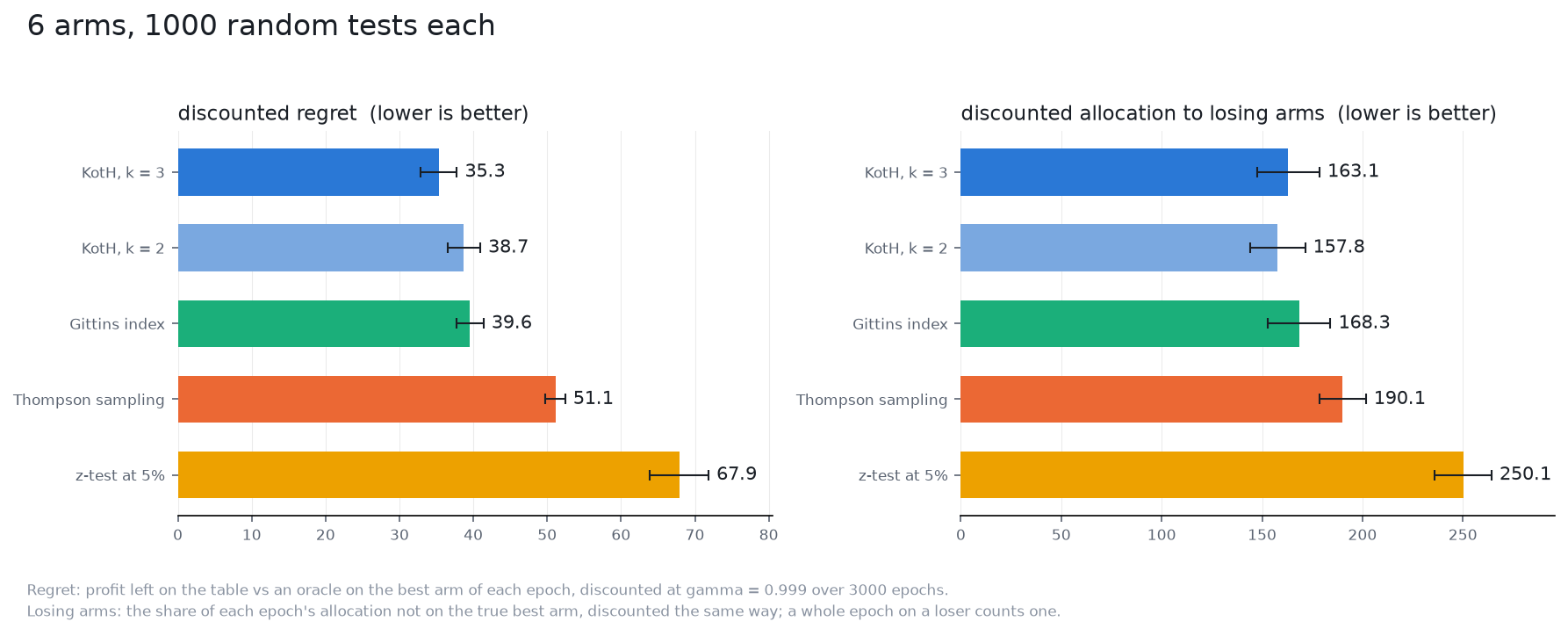
Every strategy plays the same 1000 random tests: 6 arms, true effects drawn
from N(0, 0.5), noise sigma = 1 per epoch, gamma = 0.999 (so 1/rho = 1000
epochs) over 3000 epochs, and nobody is told the effect distribution. The spec
is resources/arena.spec.yaml;
to reproduce it (seeds are fixed, ~20 min on 4 cores):
pip install koth[arena]
koth-arena simulate --spec resources/arena.spec.yaml
koth-arena plot data/arena.pkl --out resources/arena.png
Some notes:
- If Gittins is "optimal", why does it still lose by a sliver? Well, Gittins is not optimal for this simulation because of the prior. In this simulation, we don't tell strategies the range of effects we are sampling from. They have to start from somewhere "flat". This is more realistic: in "real life", the range is but a well-informed guess.
- The numbers on the right are just a measure of of how much deliberate exploration each strategy took. This answers the "how much time?" question; the "money question" is still answered solely by regret.
That is for independent arms, where you would expect Gittins to work well. What about correlated arms? In the plot below, we simulated a "marketing campaing bid" by drawing uniform points from a Gaussian process with ever increasing correlation between neighbourig bids:
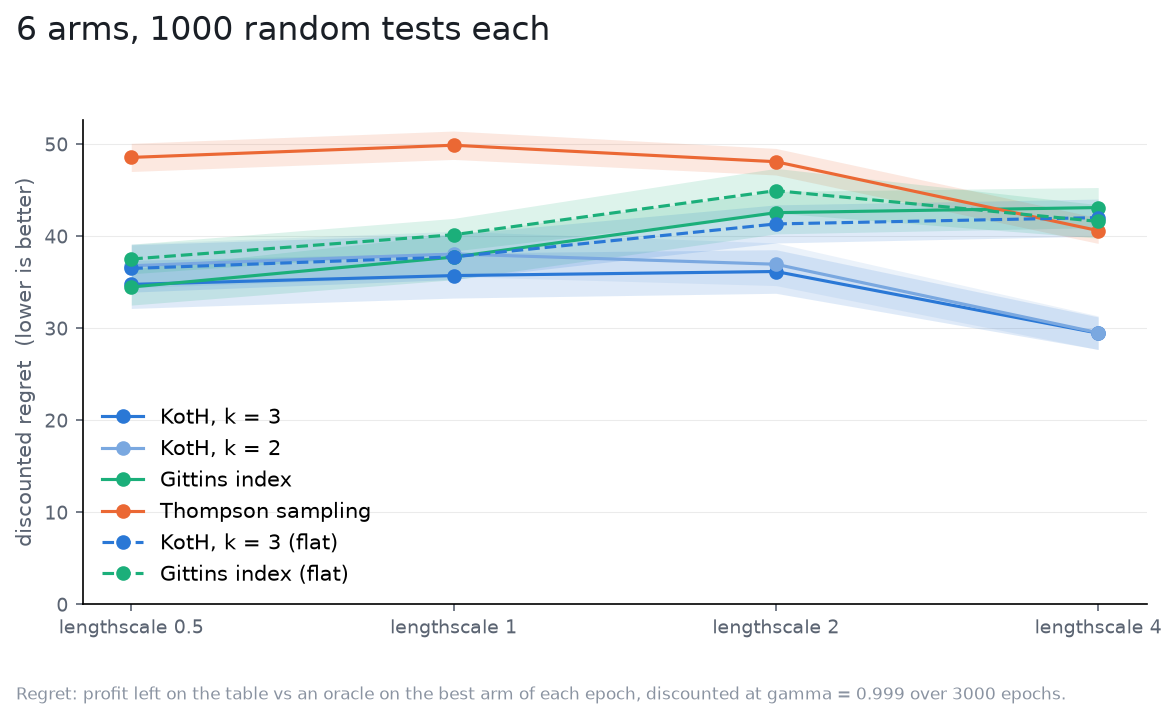
The full study, with the table and the spec that produced it: docs/correlation/bids.
Now one can see the KotH strategies clearly and decisively winning. It behaves like you expect: the more correlation, the better, since there is less to learn. The other strategies (Gittins and "flat" KotH, i.e. with no information of the correlation) degrade instead. TS improves because it can also take advantage of correlation. For more information, see the full analysis.
- Correlated arms: the case the package exists for, arms whose effects are tied to each other and a prior that says how.
- Robustness: what it costs when the world is not the model, for KotH and for the baselines: a wrong
sigma, outliers, drift, and coarse Bernoulli data.
-
Does this test tell me when to stop testing? No, emphatically. KotH will eventually stop, but it's out of its own convenience. To know when a test should be stopped, one needs to know the opportunity cost of stopping (testing is always beneficial, even if 0.00001% beneficial. If you have no external reason to stop a test, why stop ever?). This is not modeled here and it would be downright dishonest to imply that it could tell you when to stop without taking opportunity cost into consideration. BTW, do you even know yours?
-
What the heck is
rho? That is your time preference: how fast you want to get results. It is your answer to "one marshmallow today or two tomorrow?". If you want results right now, you must live with the probability of being (most likely) wrong. You cannot want results "in the long run", because in the long run you will be dead. The inverse ofrhois measured in time units (if your data comes every day, it's in days, in hours, it's in hours, etc...) and is the timescale by which one marshmallow then is worth ~36% of a marshmallow now. -
What about drift and parameter changes? You don't model those! They make the computed base models way more complex to train reliably. In addition, they are a "second order" problem. A simple solution you can make is to cap your input data to a reasonable horizon (i.e., recalibrate often). This should give you 80% of the real deal.
-
Where do
meanandcovcome from? From you: they are your posterior over the arms' effects (control included), in whatever units your metric has (KotH never sees your raw data). For the common shared-control case, that is just one mean and one variance per arm,cov = diag(var): the correlation between lifts (every lift shares the control's noise) is derived by KotH from the control's variance, you do not enter it. If you have a prior from past tests (empirical Bayes, correlated or not),covis exactly where it goes. -
What is
sigma? And my arms have different noise levels!sigmais the noise of one arm's estimate over one epoch at full allocation, and it is the same for every arm. That is not laziness: the inner maximization is a quadratic only becausesigma**2factors out of the observation covariance. Conversion rates are within a few percent of this (p(1 - p)barely moves between arms). Revenue-vs-conversion arms are a different problem, not a parameter. -
My metric is a conversion rate, not Gaussian! The Gaussian is on your posterior of the rate, not on the clicks. After a few conversions per arm, that is a fine, if crude approximation. Below that, for sparse data, this indeed might not be the package for you.
-
How many arms can I throw at it? Which
k? Each decision evaluates everyk-subset: 12 arms is 66 pairs or 220 triples, 50 arms is 1,225 pairs or 19,600 triples. KotH3 is cubic in arms while KotH2 is quadratic (Koth4 would be quartic, yikes!). To add insult to injury, the underlying network for KotH3 is also way bigger than KotH2. Depending on what you are doing, KotH2 might just beat the tradeoff by quite a margin. -
Where is the math? In the pinn repo:
kb/holds the derivations, and the graveyard of what did not work.